Description . .
.
The play begins
in a stately English country manor during the Romantic Age. The illustrious
poet, Lord Byron, is visiting Sidley Park at a time when the audience
begins to wonder just who was  engaged
in "carnal embrace" with Mrs. Chater in the gazebo? Was it Septimus
Hodge, the tutor to Lord and Lady Croom's brilliant daughter Thomasina?
Was it Captain Brice, Lady Croom's dashing brother? Or was it Lord Byron
himself, described by Caroline Lamb as "mad, bad and dangerous to know"? engaged
in "carnal embrace" with Mrs. Chater in the gazebo? Was it Septimus
Hodge, the tutor to Lord and Lady Croom's brilliant daughter Thomasina?
Was it Captain Brice, Lady Croom's dashing brother? Or was it Lord Byron
himself, described by Caroline Lamb as "mad, bad and dangerous to know"?
Left with these
questions, the play continues on the same set, in the same room, only
two centuries further on in time. We now see the modern Croom family
and the modern literary researchers, Hannah and Bernard, trying to discover
just what was going on at Sidley Park during that fateful visit of Lord
Byron. As the historians find the letters and the reviews, they piece
together the past. Are they right? Or do they have it completely wrong?
The audience knows some of the answers, but only Stoppard knows them
all, until the play's poignant resolution.
All of the elements
of Romance are presented as the play unfolds. There is a challenge to
a duel with pistols at dawn, there are secret trysts, burned letters,
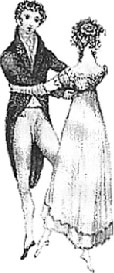
misunderstandings, flirtations, passionate piano concertos, and waltzes
by candlelight.
 Underneath
the scandalous plot that titillates the heart, many profound ideas are
presented to titillate the mind. The play's main theme is that the future
seems quite predictable and determined, until sexual attraction steps
in to muddle everything up. As Valentine, a descendant of the Croom
family says, "the unpredictable and the predetermined unfold together
to make everything the way it is." Love is viewed as "the
attraction Newton left out" because it ultimately changes the expected
outcomes of life. Modern ideas of math such as fractals and chaos theory
are explored in relation to the predictability of the future, and their
relative importance when compared to the contributions of a great philosopher,
or poet, such as Byron who gave posterity, "she walks in beauty,
like the night of cloudless climes and starry skies, and all that's
best of dark and bright meet in her aspect and her eyes." Underneath
the scandalous plot that titillates the heart, many profound ideas are
presented to titillate the mind. The play's main theme is that the future
seems quite predictable and determined, until sexual attraction steps
in to muddle everything up. As Valentine, a descendant of the Croom
family says, "the unpredictable and the predetermined unfold together
to make everything the way it is." Love is viewed as "the
attraction Newton left out" because it ultimately changes the expected
outcomes of life. Modern ideas of math such as fractals and chaos theory
are explored in relation to the predictability of the future, and their
relative importance when compared to the contributions of a great philosopher,
or poet, such as Byron who gave posterity, "she walks in beauty,
like the night of cloudless climes and starry skies, and all that's
best of dark and bright meet in her aspect and her eyes."
|