Computer Science 2
|
Computer Science 2 |
| jody@acm.org | ||
 |
|
|
|
|
|
|
|
 |
 |
 |
 |
 |
 |
 |
|
 |
|||||||
| Title: | Computer Science 2 |
| Institution: | Metropolitan State College of Denver |
| Course ID: | CSI 2050, Section 3 |
| Semester [CRN]: | Fall 2005 [51833] |
| Meeting Times: | Tuesdays and Thursdays, 7:00 PM - 8:50 PM |
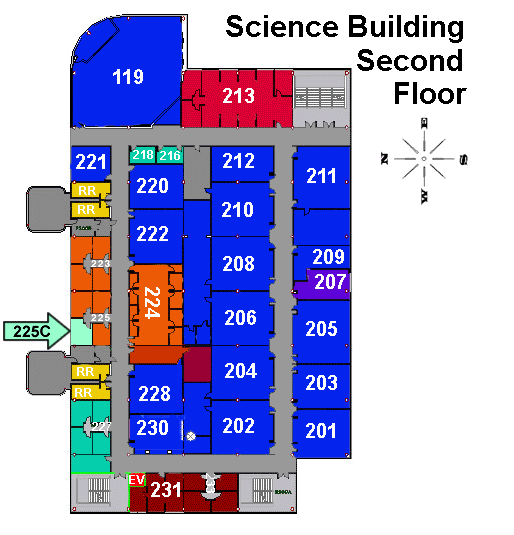
| Location: | SI 228 |
| Credit Hours: | 4 |
| Official Info: | This course is a continuation of the Computer Science core sequence, emphasizing the concepts of object-oriented software development, data representation and algorithmics. |
| Course Website: | http://www.jodypaul.com/cs/cs2 |
| Instructor: | Dr. Jody Paul (schedule & office hours) |
| E-mail: | jody@cse.mscd.edu |
| Office: | Science 133C (x68435) |
| Campus Mail: | Campus Box 38 |
 Date/Time To Be Determined by AHEC (SI 228) Requirements specifications for "Course Grade Tracking" project JUnit test classes for
input validator (Assessment Rubric) Due October 6 InputValidatorQueue implementation Due October 24 Exam Reference: ExNode Huffman Coding References: ImageLab Project: ImageLab.zip
Date/Time To Be Determined by AHEC (SI 228) Requirements specifications for "Course Grade Tracking" project JUnit test classes for
input validator (Assessment Rubric) Due October 6 InputValidatorQueue implementation Due October 24 Exam Reference: ExNode Huffman Coding References: ImageLab Project: ImageLab.zipTentative Schedule for Fall 2005:
• Weeks 1–2
Review of CS-1 Material
Software Engineering (Life Cycle; Test-First Development; Refactoring)
Problem Analysis & Requirements Engineering
Solution Design (Architecture; Algorithms: Sequential, Conditional; Recursive, Iterative)
Object Oriented Analysis / Design / Programming (Inheritance; Polymorphism)
Documentation (UML, javadoc)
Java Language (Syntax; Variable Scope & Lifetime; Collections & Arrays; Interfaces)
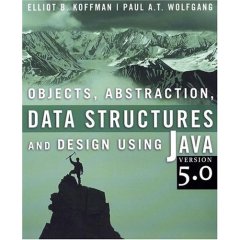
Java Textbook Chapters 1–4, 6, Appendix B
• Weeks 3–4
Program and Algorithm Analysis
Stacks & Queues
Java Textbook Chapters 2, 5, 6
• Weeks 5–7
Trees (Introduction)
Binary Search Trees
Heaps & Priority Queues
Java Textbook Chapter 8
• Week 8
Midterm Exam
• Weeks 9–10
Sets
Maps
Hash Tables
Java Textbook Chapter 9
• Weeks 11–12
Searching & Sorting
Java Textbook Chapter 10
• Weeks 13-15
| This course, a continuation of CSI 1050, further develops the fundamental concepts of Computer Science and Object-Oriented Software Engineering. Data structures covered include stacks, queues, linked-lists and trees. Algorithms for sorting and searching are developed and analyzed. This semester, the Java programming language will be used to illustrate the concepts and to develop facility with their application. Students should expect to spend at least 10 hours per week outside of class, learning the theory and applying it to software-development assignments. This is an estimate for an average, well-prepared student. Some students may require more than twice this amount of time outside of class. Note that this estimate is an average over the entire semester and that the workload is not uniformly distributed. |
| You are expected to participate in class discussions and in-class exercises. There are no "make-ups" for missed in-class activities and exercises. Note that significant information will be disseminated during class sessions or on course web pages that you will be responsible for knowing whether or not you attended the sessions or accessed the website. That is, not all information necessary to successfully complete the assignments or examinations is covered in the textbook. Your final course grade is determined by first associating a Pass/Fail assessment based on the completion of all required assignments, then combining your scores on exercises, assignments and exams. In order to receive a passing grade (A B C or D), you must successfully complete all required assignments and receive a passing grade on the Final Exam. Your actual letter grade is guaranteed to be no lower than that computed by the following distribution of total points and weighted average conversion to letter grade:
Any assignment that is not turned in on time will receive no more than 50% of the possible points. Missing the final exam will result in a course grade of F. Missing the midterm exam will result in a midterm exam grade of 0 and a maximum possible course grade of D. Late homework and make-up exams will not be accommodated without prior arrangement and written agreement. Unforeseeable crises and emergency situations will be dealt with on a case-by-case basis in accordance with MSCD, College, and Departmental policies. The work you turn in must be your own, created by you individually. Collaboration and discussion with fellow students concerning course information, materials, and studying for exams is encouraged. However, to provide fair assessment for grading and maximized benefit from the learning experience, work you turn in must reflect your individual effort. Turning in work that is the result of unauthorized collaboration or copying will be treated as academic dishonesty and an attempt at fraud. All incidents of suspected dishonesty will be reported to the department and the Dean of the College. Consequences may include a grade of 0 on the assignment or exam, a grade of "F" for the course, academic probation, or dismissal from the institution. This is a very serious matter and should not be taken lightly. If you have any uncertainty or concerns, please discuss them with your instructor or advisor. |
Observance of religious holidays follows College policy, which is posted on the web at http://handbook.mscd.edu in the section "Academics – Everything to Know About Grades". Each student is responsible for understanding and abiding by the policy.
Students desiring a reasonable accommodation under the ADA must contact
the instructor immediately to discuss their needs. You will need to supply a disability verification letter from the Disability Services office (Auraria Library, Room 115) before the instructor can make appropriate accommodations. Failure to notify the
instructor in a timely manner of the need for a reasonable
accommodation may hinder the college's ability to assist students in
successfully completing the course.
©2003,2004,2005 Dr. Jody Paul