Computer Science 1 (CS1050)
Course Information
| Title: | Computer Science 1 |
| Institution: | Metropolitan State University of Denver |
| Course ID: | CS 1050, Section 6 |
| Semester: | Fall 2018 |
| Meetings: | Tuesdays & Thursdays 2:00PM - 3:50PM |
| Location: | AES 250 |
| Hours: | Credit Hours: 4 Contact Hours: 60 Additional Student Work Hours: 120 hours minimum outside of class* |
| Prerequisites: | Permission of the Department |
| Policies: | http://www.jodypaul.com/cs/cs1 |
| Moodle Site: | http://gouda.msudenver.edu/moodle |
| Instructor: | Dr. Jody Paul (schedule & office hours) |
| E-mail: | jody @ computer . org |
| Office: | AES 200X (x50978) |
| Campus Mail: | Campus Box 38 |
*Achieving a basic level of competence in the knowledge and skills for this course requires students to invest substantial time outside of the classroom. This includes extensive hands-on practice. The nominal 120 hours outside of class is considered a minimum and may be insufficient to guarantee success. |
|
Catalog Text
This is the first course in the computer science core sequence. Students will learn a modem programming language and the basic skills needed to analyze problems and construct programs for their solutions. The emphasis of the course is on the techniques of algorithm development, correctness and programming style. Students are also introduced to the fundamentals of software engineering and the software development life cycle.
Course Description
Students are introduced to fundamentals of computer science and learn the basic techniques for analyzing problems and for designing, constructing, validating and maintaining computer-based solutions. The course addresses methods for problem specification and analysis, the design of software-based solutions, and the basics of software engineering most critical to success.
This semester, the Java programming language will be used to illustrate the computer science concepts. The BlueJ integrated learning and development environment will be used to facilitate implementation and experimentation.
Textbooks
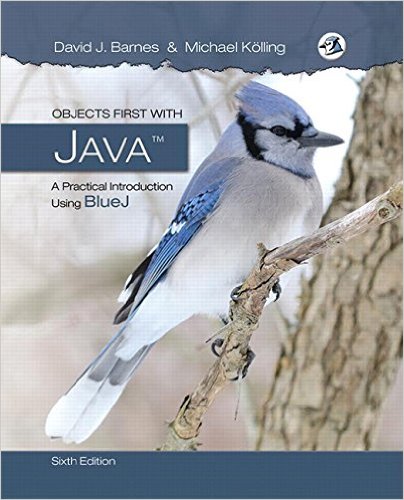 Objects First with Java:
A Practical Introduction Using BlueJ (6th Edition)
by David J. Barnes & Michael Kölling
Pearson (2016); ISBN 0134477367
REQUIRED
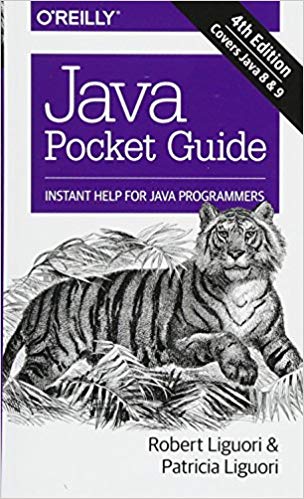 Java Pocket Guide: Instant Help for Java Programmers 4th Edition
by Robert Liguori & Patricia Liguori
O'Reilly (2017); ISBN 1491938692
STRONGLY RECOMMENDED
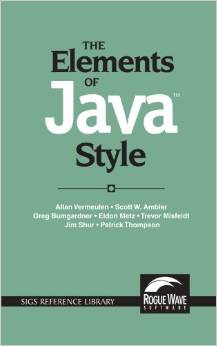 The Elements of Java Style
by Allan Vermeulen, et al.
Cambridge University Press (2000); ISBN 0521777682
RECOMMENDED
Resources
 BlueJ – Java Learning & Development Environment
 CodingBat – Java coding practice
 |
|
Course Policies
Scoring & Grading
Graded items include assignments, tests, and in-class activities. Not completing a graded item earns a grade of F for that item. Items have different relative weights. The final course grade is the weighted combination of all item grades.
Common Final Exam
This semester there is a planned administration of a required common final examination across all sections of CS 1050. The exam will likely be scheduled for the Saturday of the last week of classes. If you are aware of a conflict with the specified date and time, please inform the Department office so that they can schedule an alternate time.
This common final will replace the scheduled final exam during finals week. The common final will be a closed book and note exam, without use of a computer. A mini-reference document will be handed out at the start of the test. You will receive a copy this document as early in this semester as the committee can produce it.
Here are links to more information about the common final exam.
Class Sessions & Websites
Students are expected to prepare in advance for class sessions (readings, exercises, forum posts, assignments, etc.) and to participate in class discussions and collaborative activities. Participation in class discussions and activities is mandatory and constitutes part of the overall grade for the course. There are no “make-ups” for missed in-class activities and exercises.
Much information is disseminated during class sessions. Additional information is provided via the course website. All students are responsible for knowing this information whether or not they attended the sessions or accessed the website. In particular, the textbooks and references provide some but not all of the information necessary to successfully complete the course.
In addition to important course and domain information, the course support website (Moodle) provides the primary vehicle for managing assignments and other assessments.
Deadlines (Due Dates/Times)
Deliverables associated with assignments may be submitted for scoring at any time prior to the published deadline (due date/time).
No assignment deliverables will be accepted after the published deadline.
In the past, the most successful students applied the strategy of setting their own "individual" target deadlines to be 24 hours in advance of the published deadlines. In support of this practice, out-of-class assignments will have due dates/times that provide ample time for completion and delivery more than 24 hours prior to the published deadlines.
Because there are many risks to completion and submission, you are strongly encouraged to target completion of an assignment no less than 24 hours prior to the published deadline and to submit an assignment no less than 12 hours prior to the published deadline.
Illnesses, crises, and emergency situations will be dealt with on a case-by-case basis in accordance with University, College, and Departmental policies.
Assignments & Projects
Assignments and projects are opportunities to learn new concepts and skills, practice applying those concepts and skills, and reflect on experiences. The intent is to enhance understanding as well as to demonstrate knowledge and its application. Details regarding assignments and projects will be provided in class or on the course Moodle website.
Assignments must be turned in using the course Moodle website unless explicitly specified otherwise. In particular, e-mail and hard-copy will not be accepted in lieu of online submission.
Reflections
Every assignment and project turned in must include a section (~150 words) labeled “Reflection” that describes personal insights and observations about the learning resulting from reflecting on the experience. This reflection is required whether or not the assignment specification mentions it explicitly and comprises a portion of the grade of every assignment and project. (If a reflection is not required, the assignment specification will explicitly state that exception.)
Online Submission
Assignments must be turned in using the course Moodle website unless explicitly specified otherwise. In particular, e-mail and hard-copy will not be accepted in lieu of online submission.
Deliverable Formats
When available, the Online text field of a Moodle assignment is to be used for text-based responses and for reflections. File attachments to Online text are generally not acceptable.
Formats of files turned in for assignments must not depend on specific operating system or commercial software.
- Examples of generally acceptable formats: ASCII or UNICODE UTF-8 text, HTML, PDF, GIF, JPEG, PNG.
- Examples of specifically unacceptable formats: Microsoft Word, Apple Pages, Microsoft PowerPoint, Apple Keynote, Microsoft Excel, Apple Numbers.
- Acceptable formats for archives include only tar and zip.
If a specific archive or file format is required it will be specified in the assignment itself.
A deliverable submitted in an unacceptable format is equivalent to no submission at all. If unsure about the acceptability of a file format, please check with the instructor prior to submission and well before the deadline.
Quiet Period
The 24-hour period immediately preceding the published deadline for an assignment is considered a quiet period. During that 24-hour interval, the instructor may not be available to address questions directly referencing specifics of that assignment. All students are strongly encouraged to complete assignments well in advance of this quiet period. Further, since computer systems and networks commonly and often experience "down times", students should not depend on such systems, including the course support servers, to be consistently available during that period.
Collaboration & Citation of Sources
Successful programming is rarely a solitary endeavor devoid of external contributions. Collaboration, teamwork, and consultation of work by others are the norms.
Collaborative activity is required for successful completion of this course. In particular, collaboration is encouraged and regarded as an essential aspect of learning computer science and programming. Collaboration and discussion with fellow students and instructors concerning course information, materials, assignments, projects, proofreading, concept exploration and studying for exams is strongly encouraged. You are not expected to learn the course content or work on assignments and projects completely in isolation.
That said, in order to provide fair assessment for grading, the work you turn in must be your own. You must write up your own submissions, reflecting your individual effort, for every assignment you turn in to be assessed, even if the solution results from collaborative effort.
In your submission, you must identify and credit the people with whom you worked or consulted.
Your submission must explicitly reference all sources consulted and indicate where and how they apply.
Academic Dishonesty
Turning in work that includes quotations without corresponding citations, does not properly cite references, or does not credit collaborators, will be treated as an act of academic dishonesty. Failing to abide by examination policies will be treated as an act of academic dishonesty. All incidents of suspected dishonesty will be reported to the Chair of the department and the Dean of the college. Consequences may include no credit for the assignment, a grade of "F" for the course, academic probation, or dismissal from the institution. This is a very serious matter and should not be taken lightly. If you have any uncertainty or concerns, please discuss them with your instructor or your advisor.
Official Information
Official policies applicable to all courses may be accessed at https://msudenver.edu/math/policies
- General University Policies
- Grades and Notations including WITHDRAWAL FROM A COURSE, ADMINISTRATIVE WITHDRAWAL,
and INCOMPLETE POLICIES
Students should be aware that any kind of withdrawal can have a negative impact on some types of financial aid, including scholarships. - Accommodations to Assist Individuals with Disabilities
- Academic Dishonesty
- Class Attendance on Religious Holidays
- Prohibition of Sexual Misconduct
- Electronic Communication (Student Email) Policy
MSU Denver Academic Calendar: http://www.msudenver.edu/events/academic/
Additional official dates and deadlines, including the last dates to withdraw and holidays
MSU Denver Student Rights and Responsibilities: http://catalog.msudenver.edu/content.php?catoid=28&navoid=1780
Policy documents provided by the Department of Mathematical and Computer Sciences:
CLAS Syllabus Policies Fall 2018finalREV.docx
Deadline Dates Fall 2018.doc